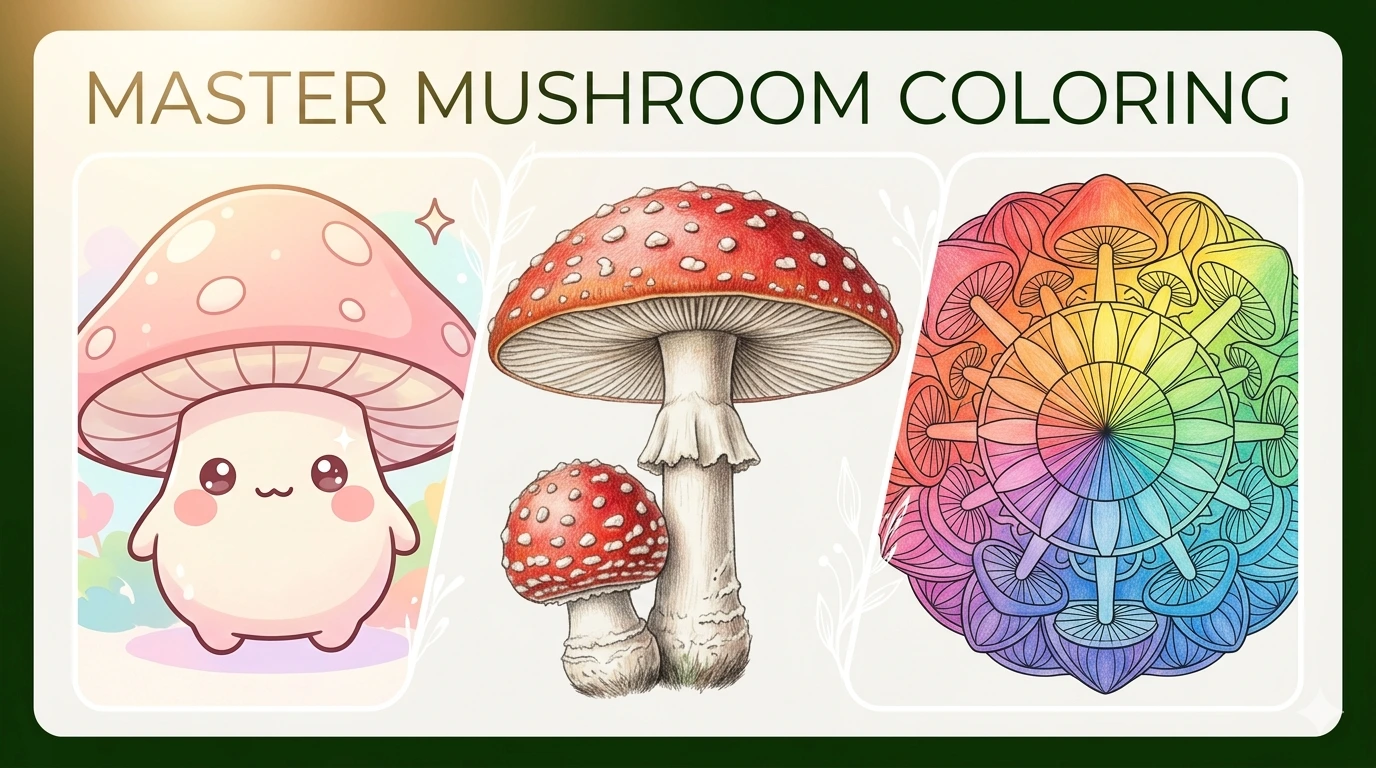
Whether you are just starting your mushroom coloring journey or looking to take your technique to the next level, this complete guide covers everything you need to know to create beautiful mushroom coloring pages. From choosing the right tools to mastering realistic shading, kawaii color techniques, and mandala patterns this is the only mushroom coloring guide you will ever need.
Choosing the Right Tools for Mushroom Coloring
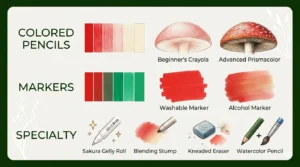
Colored Pencils – Best for Most Mushroom Styles
Colored pencils are the most versatile and forgiving tool for mushroom coloring. They offer precise control, allow for gradual layering, and create beautiful results across all mushroom coloring styles from simple kids designs to complex botanical illustrations.
- Beginners and kids: Crayola colored pencils ,affordable, good colors, widely available
- Intermediate: Faber-Castell Grip colored pencils , great pigment, comfortable grip
- Advanced: Prismacolor Premier , the gold standard for adult coloring. Soft wax core, incredibly blendable
- Professional: Faber-Castell Polychromos , oil-based, harder core, extremely precise
Markers – Best for Bold Colors and Mandalas
- Washable markers : perfect for young children. Wide tips cover large areas quickly
- Alcohol markers (Copic, Ohuhu) : smooth blending, professional results for adult coloring
- Fine-tip markers (Staedtler Triplus) : excellent for detailed mandala sections
Specialty Tools
- White Sakura Gelly Roll essential for kawaii eye sparkles and highlights on any style
- Blending stump smooth colored pencil transitions for realistic shading
- Kneaded eraser lift colored pencil to create subtle highlights
- Watercolor pencils + brush beautiful for botanical and forest scene styles
How to Color Kawaii Mushrooms?
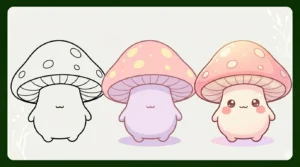
Kawaii mushroom coloring is all about softness, roundness, and maximum adorableness. Follow these steps for perfect kawaii results:
- Choose your palette: soft pastels work best – pink, lavender, mint green, baby blue
- Color the cap with light, even pressure in your chosen soft color
- Fill spots with cream or pale yellow lighter than the cap
- Color stem in a slightly lighter shade than the cap
- Add circular blush marks on cheeks with light pink the kawaii signature
- Fill eyes with very pale blue or lavender
- Add tiny black pupils, then white gel pen sparkle dot for that kawaii magic
Perfect pages to practice: /kawaii-mushroom-coloring-pages/
How to Color Realistic Botanical Mushrooms
Realistic botanical coloring requires understanding light source and mushroom anatomy. Here is a simple approach that produces beautiful results:
Understanding Mushroom Anatomy for Coloring
- Cap top: Where light hits – use lighter shades here
- Cap underside/gills: Darker, in shadow – use deeper versions of your cap color
- Stem top: Medium shade – receives some light
- Stem base: Darkest area, ground shadow – use darkest shade
Step by Step
Decide your light source from the top-left is most natural
Apply lightest shade to the highlight area first with light pressure
Build mid-tones across the main surface
Add darkest shades in shadow areas (cap edges, under cap, base of stem)
Blend transitions with blending stump or colorless blender pencil
Add final texture details: dots for pores, lines for gills
Perfect pages to practice: /realistic-mushroom-coloring-pages/
How to Color Mushroom Mandalas
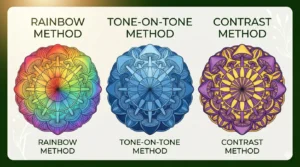
Mandala coloring has its own logic the key is consistency and intentional color placement:
The Rainbow Method (Best for Beginners)
Assign one color to each ring from center outward: red center, then orange, yellow, green, blue, violet outer ring. This foolproof method always looks stunning and requires no planning.
The Tone-on-Tone Method
Choose a single color family (all blues, all purples) and use 5–7 shades from lightest to darkest, alternating in adjacent sections. Creates an elegant, sophisticated result.
The Contrast Method
Use two complementary colors (purple and yellow, blue and orange) alternating in adjacent sections. Creates maximum visual impact and energy.
Perfect pages to practice: /mushroom-mandala-coloring-pages/
How to Color Mushrooms Digitally on iPad
- Digital coloring has become hugely popular and our mushroom pages work perfectly with digital apps:
- Download any mushroom coloring page PDF from our site
- Open Procreate (or Adobe Fresco, Medibang) on your iPad
- Import the PDF as a new document
- Set the line art layer to ‘Multiply’ blend mode this makes white transparent
- Create a new layer BELOW the line art layer
- Color on the lower layer your color fills will appear below the clean line art
- Use the Selection tool to stay within specific areas if needed
Digital advantage: Unlimited undo, infinite colors, no mess, can try multiple colorways!
Color Palette Ideas for Every Mushroom Style
Classic Red Toadstool
- Cap: Scarlet red | Spots: White | Stem: Cream | Grass: Emerald green
Pastel Kawaii
- Cap: Soft pink | Spots: Pale cream | Stem: Lavender | Background: Baby yellow
Autumn Forest
- Cap: Terracotta | Stem: Warm brown | Leaves: Rust, gold, burnt orange
Midnight Magic
- Background: Deep navy | Cap: Deep purple | Spots: Silver | Stars: White gel pen
Cottagecore Natural
- Cap: Dusty rose | Stem: Warm sand | Grass: Sage green | Flowers: Cream and lavender
Frequently Asked Questions
What is the best way to color mushrooms for a beginner?
Start with our simple mushroom coloring pages (/simple-mushroom-coloring-pages/) and use just 3–5 colors. Apply color in single, even layers without blending first. The most important thing is to enjoy the process — technique improves naturally with practice.
How do I make mushroom colors look realistic?
The key to realistic mushroom coloring is understanding that mushrooms have light and shadow. Identify where your light source is, apply lighter shades there, and gradually darken toward the opposite side. Add a slightly darker line along the cap edge to give it definition. This simple technique transforms flat color into realistic three-dimensional form.
Can I use watercolors on mushroom coloring pages?
Yes! Watercolor works beautifully on mushroom pages if you use the right paper. Print your mushroom page on 90lb watercolor paper for best results. For lighter washes, standard pages work fine. Watercolor pencils are also excellent — you get the control of pencils with the soft blended look of watercolor.
Start Coloring — Find Your Perfect Mushroom Page
- Kawaii Mushroom Pages
- Realistic Botanical Pages → /realistic-mushroom-coloring-pages/
- Mandala Pages → /mushroom-mandala-coloring-pages/
- Simple Pages for Beginners → /simple-mushroom-coloring-pages/
- All 80+ Mushroom Coloring Pages